

How Long Does a Building Permit Take in Toronto in 2026?
Official Toronto review targets for complete applications
Toronto’s published review targets apply to complete applications. They are not a guarantee for incomplete files, withheld applications, zoning issues, missing fees or drawings that require resubmission.
| Toronto review stream | Official target for complete applications | Typical use |
|---|---|---|
| House Stream | 10 business days | Detached houses, semis and row houses with not more than two dwelling units, including some ancillary buildings. |
| Small Building Stream | 15 business days | Part 9 buildings excluding houses. |
| Large Building Stream | 20 business days | Large Part 3 buildings. |
| Complex Building Stream | 30 business days | Complex Part 3 buildings. |
| Express Services | Goal of 3 business days for eligible projects | Selected small residential and small commercial scopes. |
A complete application normally means the application form is complete and signed, required plans and specifications are included, applicable law such as zoning has been satisfied, and fees have been paid.
- City of Toronto: Building permit review streams
- City of Toronto: Before you apply for a building permit
In this article
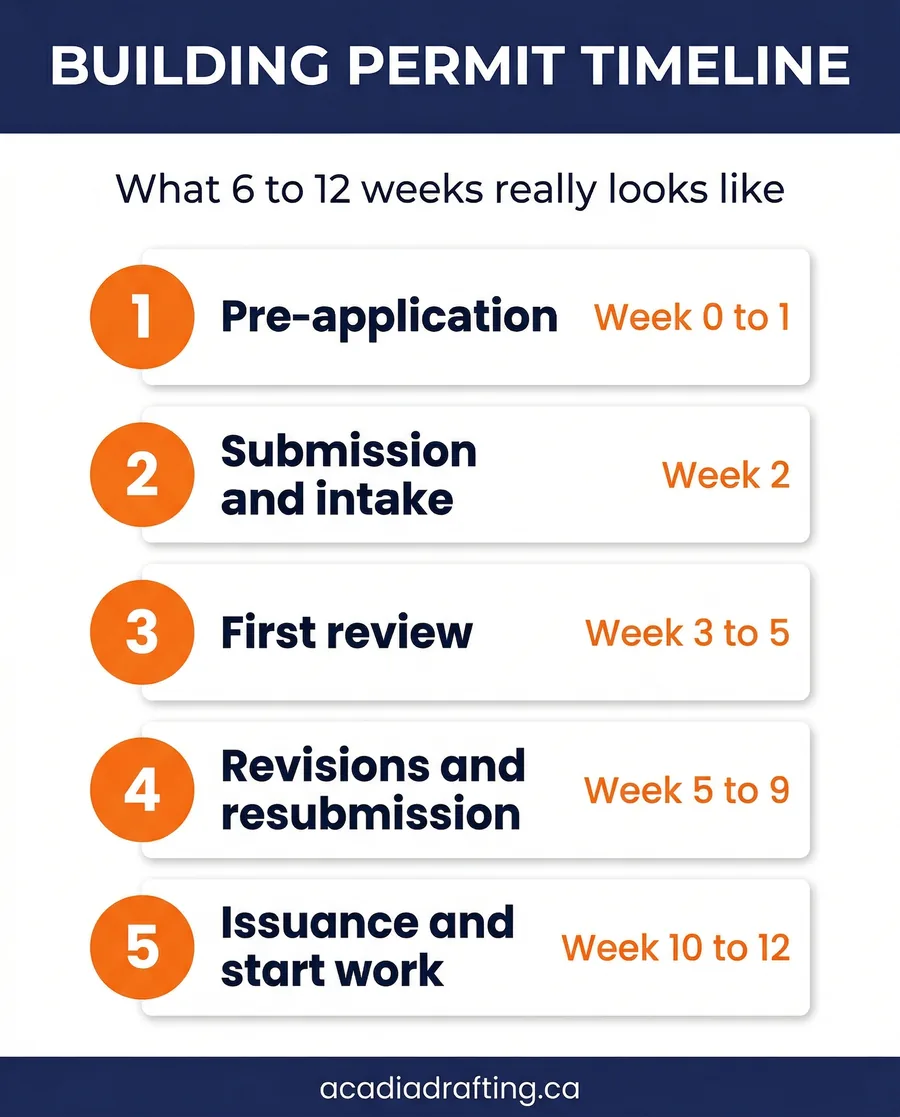
If you’re planning a renovation or addition this year, the first question is usually the same: how long until you can start work? Most homeowners I talk to looking for Toronto permit drawings budget two weeks for the permit. The real answer in 2026 is closer to six to twelve weeks for a clean residential application, and longer if anything triggers a second review. Here’s what’s actually moving applications through Toronto Building right now, and where the delays hide.
The official 10-day target nobody hits
Toronto Building publishes a 10-business-day review target for houses under Part 9 of the Ontario Building Code. That number describes the first technical review, not the whole process. After the first review you usually get a comment letter, then you revise, then you resubmit, then the file gets requeued. Each round adds two to four weeks. A first-time submission with no zoning issues and complete drawings can clear in 4 to 6 weeks. Anything missing pushes you into the 8 to 14 week range.
What the 2026 process actually looks like
Week 0 to 1: Pre-application
Site measurements, drafting, structural calculations if needed, energy compliance forms, and a zoning self-check. Skipping the zoning check is the single biggest reason files come back rejected. If your project needs a minor variance, you’re heading to the Toronto Committee of Adjustment and adding three to four months to the schedule. We flag this before drafting starts.
Week 2: Submission and intake
Toronto’s electronic permit portal does an automated completeness check. If a required form, fee, or drawing is missing the file is bounced back the same day. A complete intake puts you in the queue for plans examiner assignment, which currently takes 5 to 10 business days.
Weeks 3 to 5: First review
The plans examiner runs through zoning, OBC compliance, structural, and applicable bylaws. You either get an approval or a comment letter. Most houses get a comment letter on the first pass, even good submissions, because examiners flag things conservatively.
Weeks 5 to 9: Revisions and resubmission
Address every comment in writing, mark up the drawings, and resubmit. The file goes back to the same examiner if possible. Second reviews are faster, usually 5 to 10 business days.
Week 10 to 12: Issuance
Permit fees calculated, security deposit collected, permit card issued. You can start work the same day.
What slows things down in 2026
- Incomplete site plans. Missing setback dimensions, no grading shown, or no existing-vs-proposed overlay. Easy to avoid with proper building permit services.
- Zoning bylaw 569-2013 mistakes. Lot coverage, height, gross floor area, and rear yard depth are the four most-flagged items in Toronto.
- Structural changes without engineer involvement. Removing a wall to open a kitchen? That’s a load-bearing wall removal permits review and needs a P.Eng stamp.
- Heritage Conservation Districts. Add 4 to 8 weeks for HCD review on top of the regular permit timeline.
- Tree protection. Any work within 6 metres of a city tree requires Urban Forestry sign-off.
Mississauga, Vaughan, and the 905 reality
Outside Toronto the timelines vary more than people expect. City of Mississauga Building runs a similar 10-day target through their ePlans portal and tends to clear straightforward houses in 4 to 6 weeks. Vaughan Building Standards is currently running 6 to 10 weeks for Part 9 residential. If you’re working in the 905, regional differences matter, and we handle the local intake process directly for Mississauga permit drawings and Vaughan permit drawings clients.
If your permit comes back rejected
Rejection isn’t the end. Most rejections are technical, not fundamental, and a focused revision package gets the file back on track. We do rejected permit help for projects that stalled with another designer or that ran into a comment letter the homeowner couldn’t decode.
Save this as a PDF and keep it on hand for your project planning.
Frequently asked questions
Can I start work as soon as I submit my permit application?
No. Starting work without an issued permit triggers a stop-work order and double permit fees, and inspectors do drive by active sites. Wait until the permit card is in hand.
How long does a minor variance add to my timeline?
Three to four months. The Committee of Adjustment hearing schedule, the 20-day appeal period after the decision, and then the building permit review on top.
Are 2026 timelines longer than 2024?
Slightly. Toronto Building has been catching up on a 2023 backlog and most municipalities are running 1 to 2 weeks longer than their pre-2023 averages. Plan accordingly.
Ready to start your project?
If you have a renovation, addition, or new build coming up this year, the smartest move is to request a free quote now and get your zoning check done before construction season hits its peak in May. We work across Toronto and the GTA and handle the full process from drafting through permit issuance.