

![[2026] Guide For Secondary Suite Permit Applications in Toronto & the GTA?](https://www.acadiadrafting.ca/wp-content/uploads/2026/01/secondary-suite-permit-applications-toronto-gta-scaled.webp)
[2026] Guide For Secondary Suite Permit Applications in Toronto & the GTA?
A Complete Homeowner’s Guide to Zoning, Permits, Building Code & Legalization
Secondary suites, often called basement apartments, in-law suites, or second units, have become one of the most common residential renovations across Toronto and the Greater Toronto Area. Rising housing costs, limited land supply, and new provincial policies encouraging gentle density have made secondary suites an increasingly attractive option for homeowners.
While many people assume adding a second unit is straightforward, the reality is that secondary suites are highly regulated. Zoning rules, Ontario Building Code requirements, fire safety standards, and municipal permit processes must all be followed to ensure the unit is legal, safe, and insurable.
This guide explains everything homeowners need to know about secondary suites in Toronto and the GTA – from definitions and zoning rules to exact measurements, permit steps, and how to legalize an existing basement apartment.
For assistance with your secondary suite permit throughout Toronto and the GTA, call Acadia Drafting! Our team of permit specialists will be able to complete all zoning checks, fill out all paperwork and apply for the permit on your behalf! For full-service Building Permit applications, we are the permit drafting company for you.
Table Of Contents
1. What Is a Secondary Suite?
2. Secondary Suite vs Additional Residential Unit vs Multi-Unit Dwelling
3. Types of Secondary Suites
4. Steps to Building a Secondary Suite
5. Zoning Requirements
6. Applying for Secondary Suite Permits
7. Legalizing an Existing Basement Apartment
8. Final Checklist
What Is a Secondary Suite?
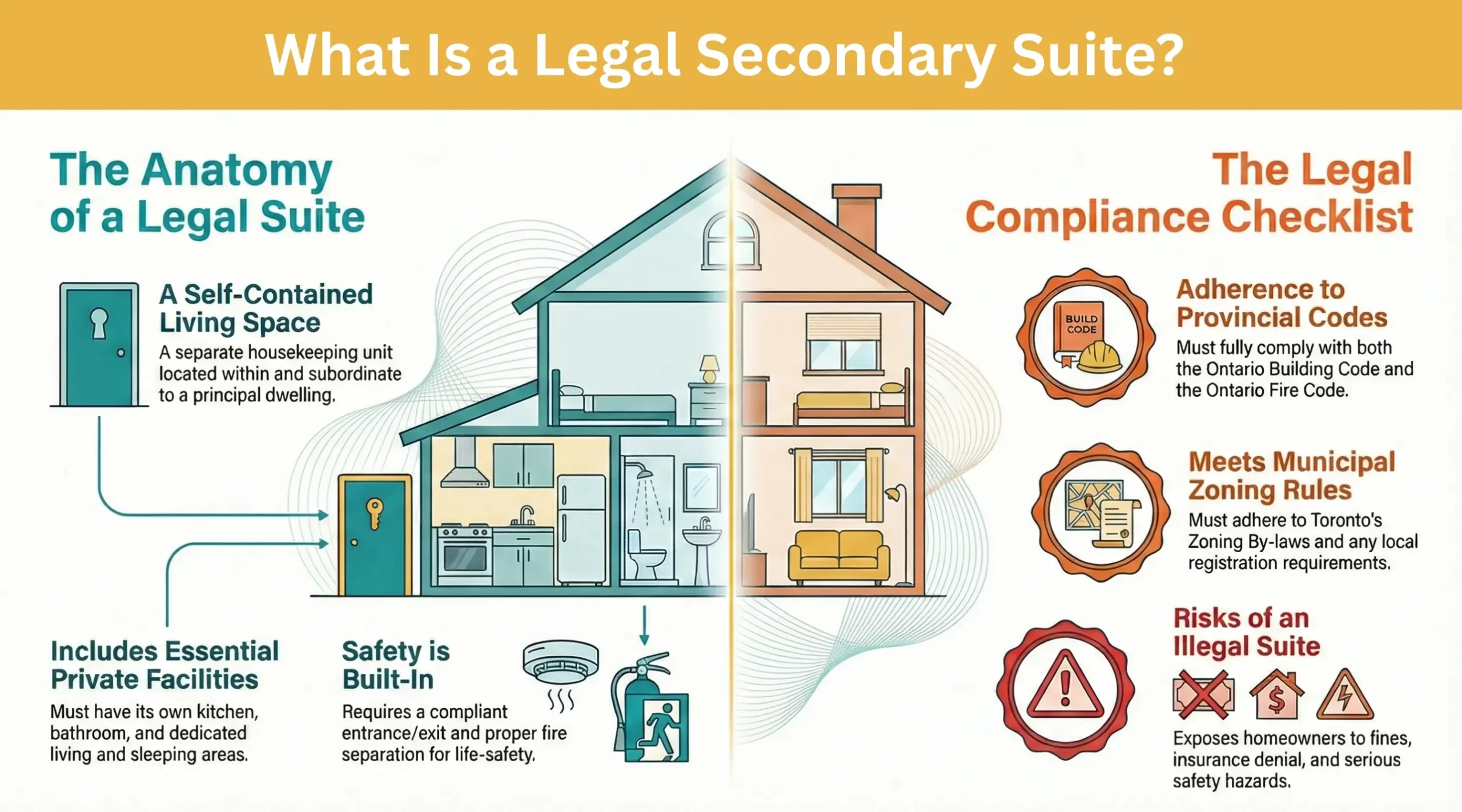
Under Toronto City-wide Zoning By-law 569-2013, a secondary suite is defined as:
“A self-contained living accommodation for an additional person or persons living together as a separate single housekeeping unit, in which both food preparation and sanitary facilities are provided for the exclusive use of the occupants of the suite, located in and subordinate to a dwelling unit.”
In practical terms, a legal secondary suite is a private, self-contained dwelling unit within a house that includes:
- A kitchen
- A bathroom
- Sleeping and living areas
- A compliant entrance and exit
- Proper fire separation and life-safety features
Secondary suites are most commonly located in basements, but they can also occupy multiple levels within a house, depending on the layout.
A legal secondary suite needs to comply with:
- Ontario Building Code
- Ontario Fire Code
- Municipal zoning by-laws
- Local registration and inspection requirements (where applicable)
This is very different from an illegal or unregistered basement apartment, which can expose homeowners to fines, forced removal, insurance denial, and serious safety risks.
What’s The Difference? Secondary Suite vs Additional Residential Unit vs Multi-Unit Dwelling
These terms are often used interchangeably, but they mean different things:
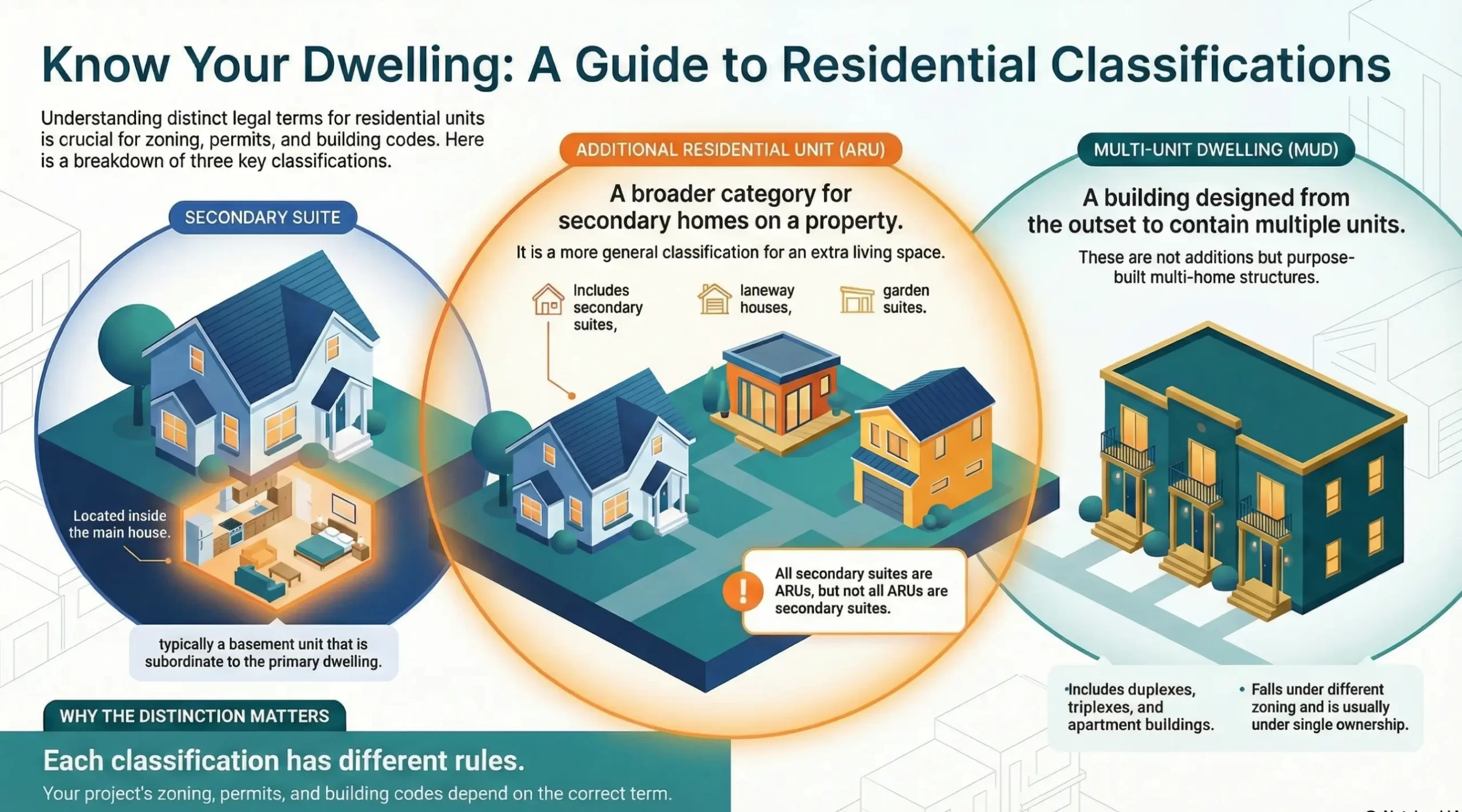
Secondary Suite
- Located inside the main house
- Typically a basement or internal unit
- Subordinate to the primary dwelling
Additional Residential Unit (ARU)
A broader category that includes:
- Secondary suites inside houses
- Laneway houses
- Garden suites
All secondary suites are ARUs, but not all ARUs are secondary suites
Multi-Unit Dwelling (MUD)
- Buildings designed to contain multiple units from the outset
- Includes duplexes, triplexes, multiplexes, and apartment buildings
- Usually under single ownership and different zoning classifications
Understanding these distinctions matters because zoning rules, permits, and Building Code requirements change depending on classification.
Types of Secondary Suites
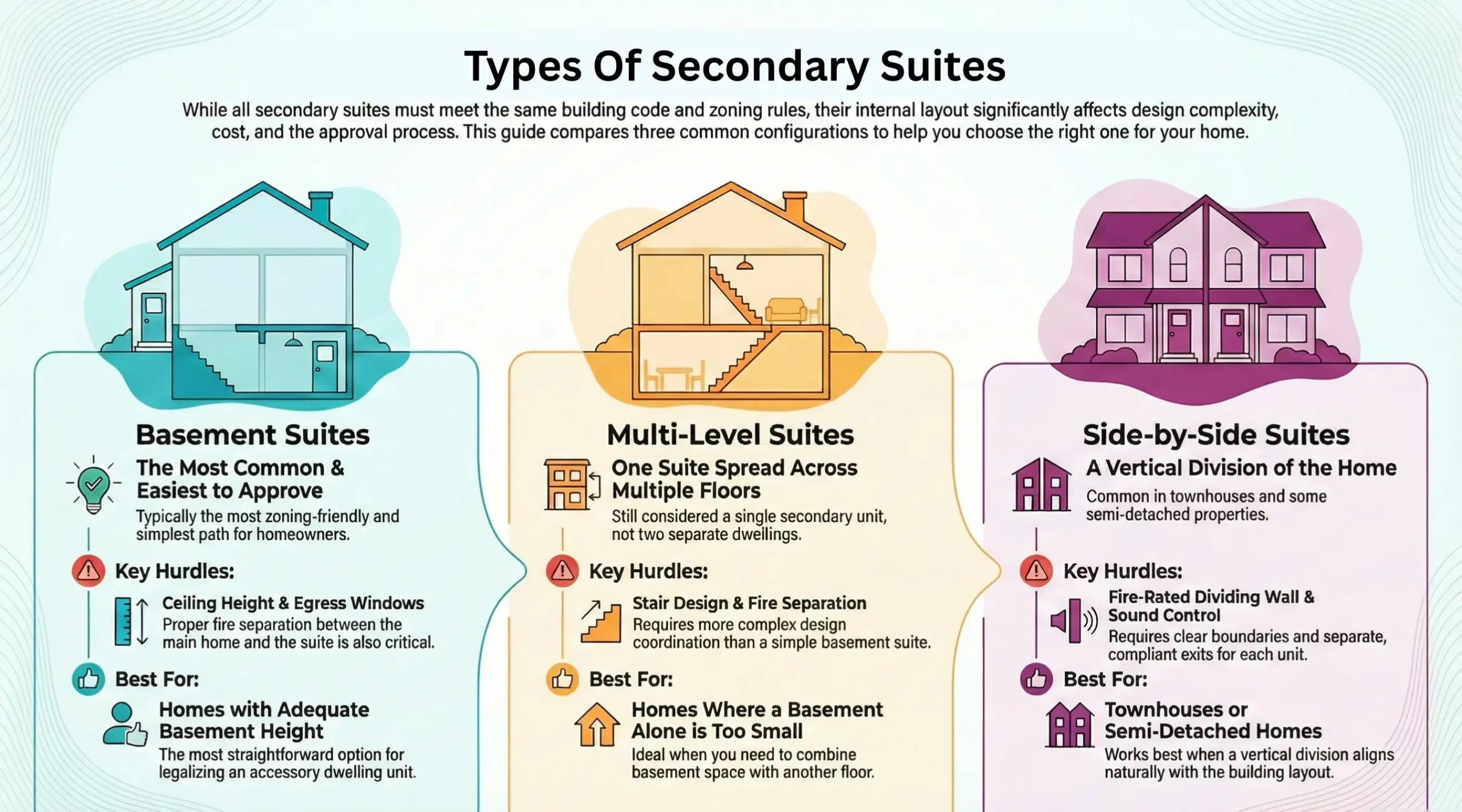
While all secondary suites must meet the same zoning and Ontario Building Code requirements, the way a suite is configured inside the house can affect design complexity, approvals, and construction cost. Some layouts are more straightforward to permit than others.
1. Basement Suites
- The most common and typically the easiest to approve.
- Usually, the most zoning-friendly option
- Best suited to homes withan adequate basement ceiling height
- Most legalization projects involve basement suites
- Approval challenges usually relate to ceiling height, egress windows, and fire separation
Best for: homeowners looking for the simplest approval path.
2. Multi-Level Suites
- A single secondary suite is spread across more than one floor.
- Still considered one unit, not multiple dwellings
- Requires careful stair design and clear separation between units
- Fire separation and ceiling heights are reviewed more closely
- More design coordination than a basement-only suite
Best for: homes where a basement alone isn’t large enough.
3. Side-by-Side / Vertical Suites
- Divided vertically rather than by floor, where each unit occupies one side or portion of the house.
- Common in townhouses and some semi-detached homes
- Units are separated by a fire-rated dividing wall rather than a floor
- Requires clear unit boundaries and compliant exits for each unit
- Fire separation and sound control between units are closely reviewed
- Typically more design coordination than in a basement suite
Best for: townhouses or semi-detached homes where a vertical division aligns naturally with the building layout.
Do All Homes Qualify For Secondary Suites?
All detached, semi-detached, and townhouses qualify for at least one secondary suite. Adding more than one requires the property to be in an R zone.
Steps to Building a Secondary Suite
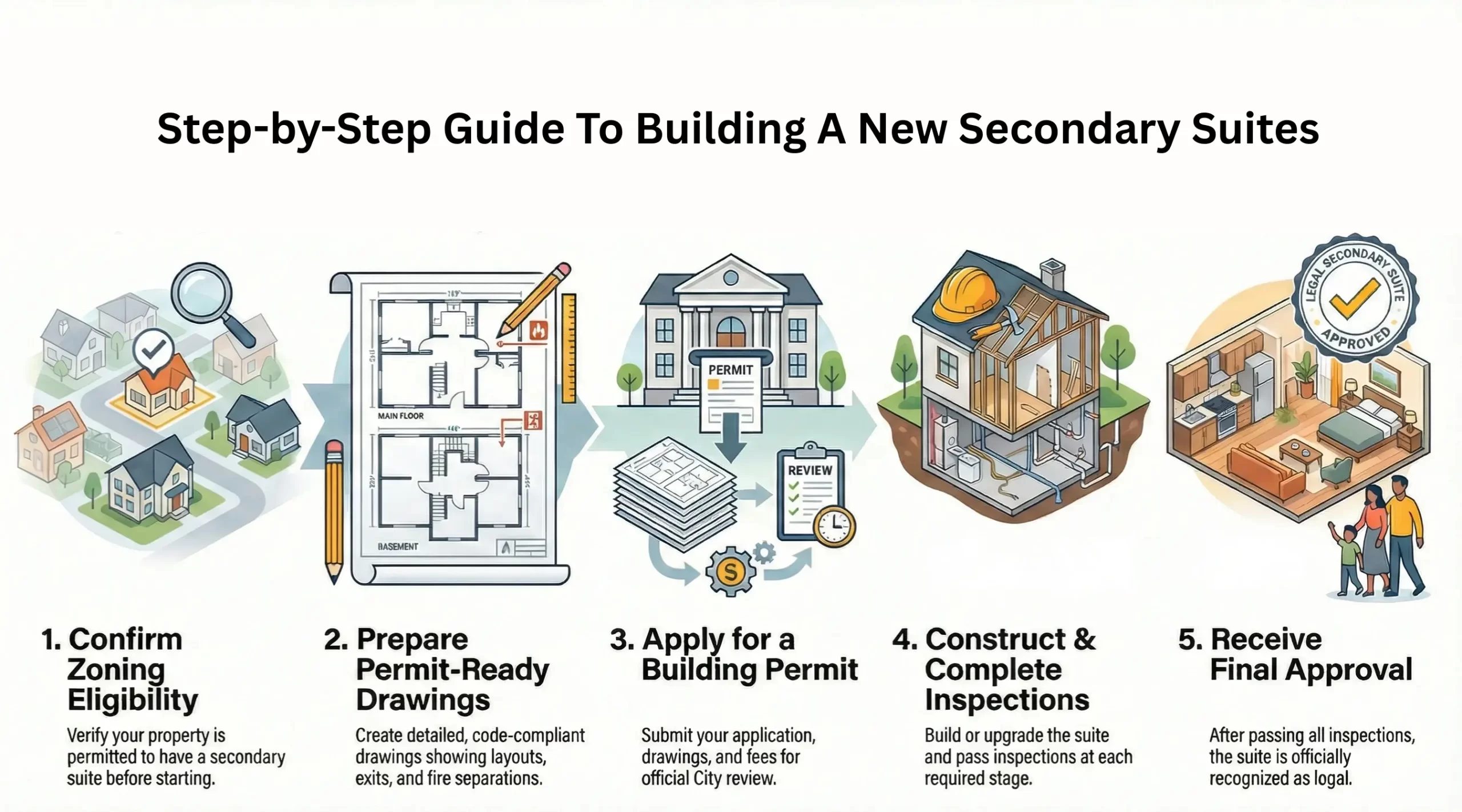
- Confirm zoning eligibility: Verify that your property is permitted to contain a secondary suite and whether any zoning relief (such as a minor variance) is required before applying.
- Prepare permit-ready drawings: Create detailed, code-compliant drawings showing layouts, ceiling heights, fire separations, exits, and building systems for City review.
- Apply for a building permit: Submit the permit application, required forms, drawings, and fees for review under zoning and the Ontario Building Code.
- Construct and complete inspections: Complete construction or required upgrades and schedule inspections at each required stage, including electrical inspections through ESA.
- Final approval and legalization: Once all inspections pass, the City approves the work and the secondary suite is officially recognized as a legal dwelling unit.
What Are The Zoning Requirements For Secondary Suites in Toronto & the GTA
Homeowners can confirm zoning by applying for a Zoning Applicable Law Certificate to ensure they submit a complete application for Building Permits.
1. Minimum Size Requirements
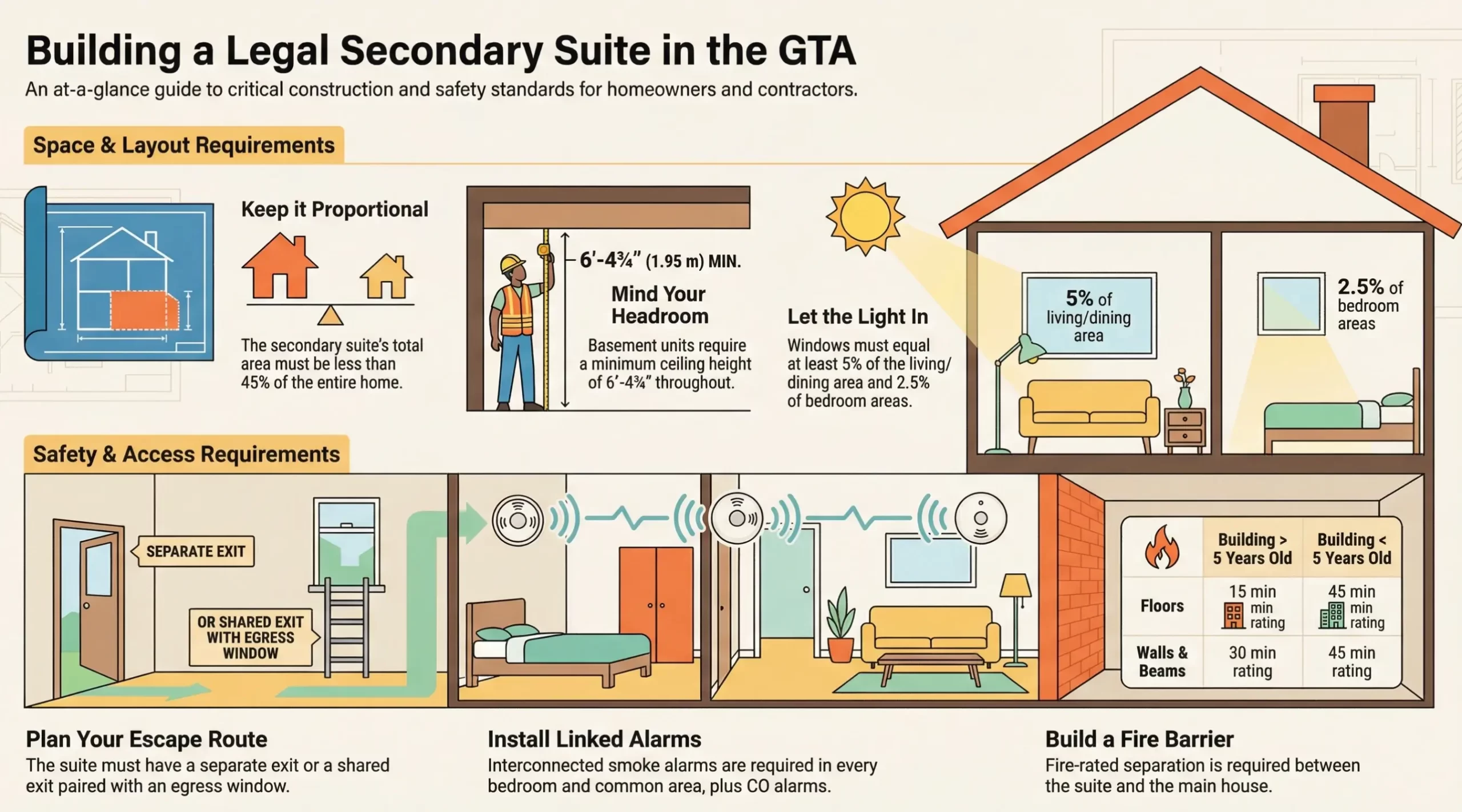
- The total area of all secondary suites must be less than 45% of the entire dwelling
- In bungalows, suites may occupy the full basement
| Space | Minimum Size |
|---|---|
| Living | 145 sq ft |
| Dining | 75 sq ft |
| Kitchen | 45.2 sq ft |
| Living + Dining + Kitchen (1-bedroom suite) | 118.4 sq ft |
| Combined Sleeping + Living + Dining + Kitchen (open concept) | 145 sq ft |
| Master Bedroom | 95 sq ft |
| Other Bedrooms | 75 sq ft |
2. Parking Requirements
- One parking space is required for each secondary suite above the first secondary suite
- Many Toronto properties are exempt, depending on transit proximity
- Parking shortfalls may require a minor variance
3. Egress & Exit Requirements
Separate Exit
- One egress door required
- Cannot be on the road-facing wall for detached or semi-detached homes
Shared Exit
- One egress door (not road-facing)
- One egress window is required
4. Egress Window Dimensions
Above-Grade Windows
- Minimum height: 3’-6”
- Minimum width: 1’-10”
- Maximum distance from floor: 2’-11”
Basement or Ground Level
- Minimum clear opening: 6.1 sq ft
- Minimum opening width: 18”
5. Window Requirements (Non-Egress)
| Room | Minimum Window Area |
|---|---|
| Living / Dining | 5% of floor area |
| Bedroom | 2.5% of floor area |
| Kitchen | Windows not required |
| Bathroom | Windows not required |
| Laundry | Windows not required |
6. Ceiling Height Requirements
Above-Grade Units
- 50% of the required floor area must be 6’-8”
Basement Units
- Minimum ceiling height: 6’-4¾” (1.95 m) over the entire required area
7. Fire Safety Requirements
Fire Separation
| Element | Building > 5 Years | Building < 5 Years |
|---|---|---|
| Floors | 15 min (with interconnected smoke alarms) | 45 min |
| Walls & Beams | 30 min | 45 min |
| Egress Doors | 20 min + self-closing device | Same |
8. Smoke Alarms
- Interconnected
- In every bedroom and common area
- Must meet CAN/ULC S531
9. Carbon Monoxide Alarms
- On every floor with bedrooms
- Required if gas appliances or an attached garage exist
Applying for Secondary Suite Permits
Adding a secondary suite is considered an interior alteration that creates a second dwelling unit, which means a building permit is required before any construction or legalization work can begin. This applies whether you are building a new suite or legalizing an existing one.
A building permit is required for:
- Interior alteration to add a second dwelling unit
Required Architectural Drawings
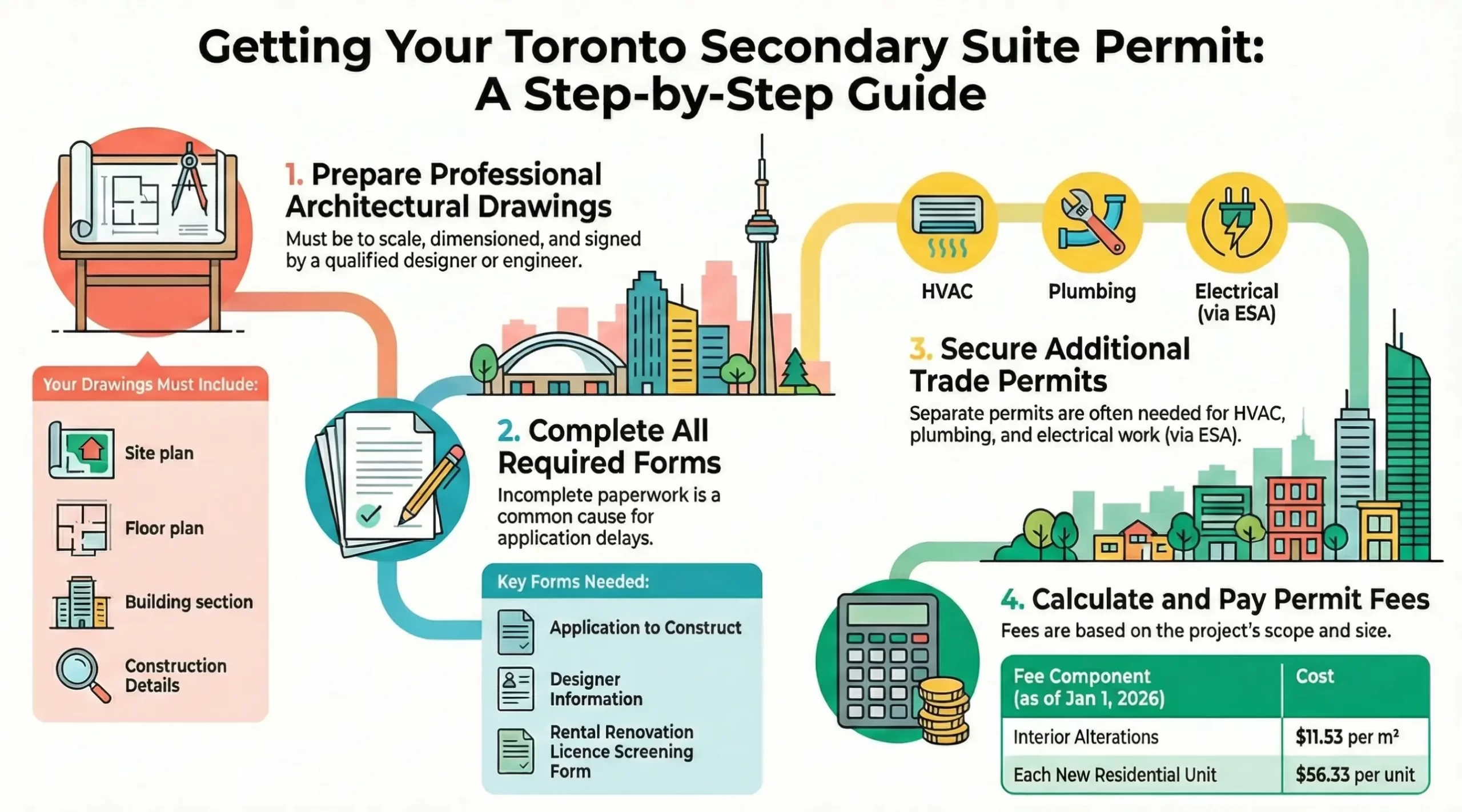
As part of the permit application, the City requires a complete set of permit-ready drawings that clearly show how the secondary suite will function and how it complies with code requirements.
These typically include:
- Site plan showing property lines, building location, setbacks, parking, and access
- Fully dimensioned floor plans for all levels, showing existing and proposed layouts, room uses, plumbing fixtures, and life-safety devices
- Building sections showing ceiling heights, floor and wall assemblies, and overall building height
- Construction details and notes outlining materials, fire separations, and typical building assemblies
These drawings allow the examiner to verify items such as ceiling height, fire separation, exits, and minimum room sizes.
All Drawings Must Meet The Following Standards:
To be accepted for review, all drawings must be:
- Drawn to scale
- Fully dimensioned
- Signed and dated
- Prepared by a qualified designer or professional engineer, as required under the Ontario Building Code
- Submitted in PDF format through the City’s online system
Incomplete or improperly prepared drawings are one of the most common reasons permit applications are delayed.
Additional Forms Required
In addition to drawings, several forms must be submitted with the application, including:
- Application to Construct or Demolish, which initiates the permit review
- Schedule 1: Designer Information, identifying who is responsible for the design
- Assumption of Responsibility for Engineering Content, if any drawings are sealed by an engineer
- Rental Renovation Licence Screening Form, required under Toronto Municipal Code Chapter 662, to determine whether a rental renovation licence is also needed
Mechanical, Plumbing & Electrical Permits
Secondary suites often trigger additional trade permits, depending on the scope of work:
- Mechanical (HVAC) permits are required if heating or ventilation systems are added or modified
- Plumbing permits are required when new fixtures or drainage are installed, typically supported by a Plumbing Data Sheet
- Electrical permits and inspections are handled separately through the Electrical Safety Authority (ESA)
These permits ensure that building systems are safe and properly installed.
Permit Fees (Effective January 1, 2026)
Permit fees are based on the scope of work and include:
- Interior alterations (Group C, E, F): $11.53 per m²
- Each new residential unit: $56.33 per unit
Additional fees may apply for related permits or approvals, depending on the project.
Legalizing an Existing Basement Apartment (Change of Use)
What’s Reviewed During Legalization
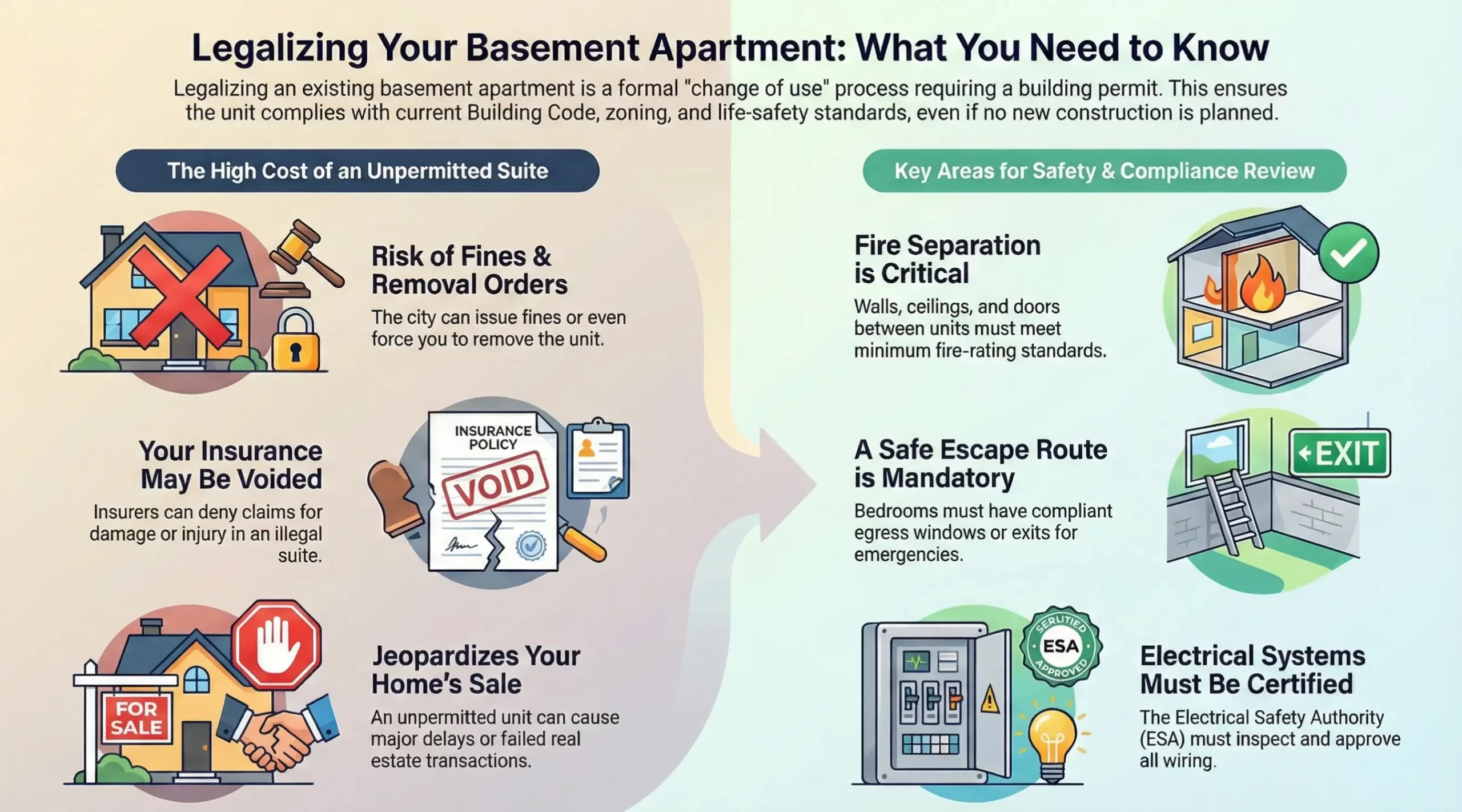
When legalizing a basement apartment, the City does not just review the layout – it evaluates whether the unit meets modern life-safety standards.
Key areas reviewed include:
- Fire separation: Existing walls, ceilings, and doors between units are often required to be upgraded to meet minimum fire-rating requirements.
- Ceiling heights: Many older homes have basement ceilings that are close to the minimum allowed height. These are carefully measured and verified.
- Egress and exits: Bedrooms must have compliant egress windows or exits that allow occupants to escape safely in an emergency.
- Electrical safety (ESA): Electrical systems must be inspected and approved by the Electrical Safety Authority to confirm they are safe and code-compliant.
- Zoning and parking compliance: The property must be permitted to contain a secondary suite, and any required parking must be provided or exempted.
In many cases, legalization involves targeted upgrades, even if the apartment appears finished or functional.
Additional Steps Homeowners Should Expect When Legalizing Basement Apartments
Legalization often includes:
- Preparing as-built drawings that reflect the existing conditions
- Opening walls or ceilings to confirm fire separation or structure
- Installing interconnected smoke and carbon monoxide alarms
- Coordinating multiple inspections (building, fire, electrical)
- Registering the unit with the municipality, where required
How Long Can Legalizating A Basement Apartment Take?
Legalizing a basement apartment typically takes longer than building a new suite, because:
- Existing conditions must be verified
- Upgrades are often required
- Inspections may reveal additional compliance issues
Timelines vary depending on the age of the home and the extent of required upgrades.
What Are The Risks of Not Legalizing a Basement Apartment
Operating an unpermitted basement apartment carries real risks, including:
- Fines and enforcement orders from the City
- Forced removal of the unit or occupancy restrictions
- Insurance denial if damage or injury occurs
- Resale complications, including delays or failed transactions
Legalization provides peace of mind, improves safety, and protects homeowners from long-term liability.
Final Checklist: Before You Build or Legalize a Secondary Suite
✅ Confirm zoning compliance
✅ Review parking requirements
✅ Confirm whether a minor variance is required (if zoning standards cannot be met)
✅ Measure ceiling heights carefully
✅ Verify fire separation conditions
✅ Confirm egress and window compliance for all bedrooms
✅ Prepare permit-ready drawings
✅ Determine if the project is a new suite or a change of use (legalization)
✅ Apply for building, plumbing, HVAC & ESA permits
✅ Plan for required life-safety upgrades (smoke & CO alarms, fire-rated doors)
✅ Schedule inspections
✅ Confirm whether registration or licensing is required after approval
Secondary suites are one of the most effective ways to add value, income, and flexibility to a home – but they require careful planning, precise drawings, and full compliance with zoning and Building Code requirements.
Many homeowners choose to work with a professional drafting company and permit team to coordinate zoning reviews, prepare compliant drawings, manage applications, and guide the project through approvals efficiently and correctly.
Book your FREE quote for secondary suite permits with us today!